5 Surprising Reasons the Internet is No Longer for Humans
There was a time, not so long ago, when the internet felt like a global town square—a messy, human-centric space defined by personal blogs, niche forums, and authentic, if sometimes amateurish, creativity. We are now witnessing the "Vibe Shift of 2026," a transition into what critics have dubbed the "Slop Era." This is not merely a change in aesthetics; it is the industrialization of the uncanny.
CORPORATEGENERAL
Bolads
7/5/20265 min read
The Slop Era: 5 Surprising Reasons the Internet is No Longer for Humans
There was a time, not so long ago, when the internet felt like a global town square—a messy, human-centric space defined by personal blogs, niche forums, and authentic, if sometimes amateurish, creativity. We are now witnessing the "Vibe Shift of 2026," a transition into what critics have dubbed the "Slop Era." This is not merely a change in aesthetics; it is the industrialisation of the uncanny.
The digital landscape has been overtaken by AI Slop: high-volume, low-quality synthetic media generated by artificial intelligence that prioritises speed and quantity over substance. According to recent data, we have officially reached a watershed moment: human beings are no longer the primary residents of the World Wide Web. The internet is no longer a place for us to talk to each other; it has become a feed-trough for machines.
1. The Human Minority: We’ve Reached the 57% Tipping Point
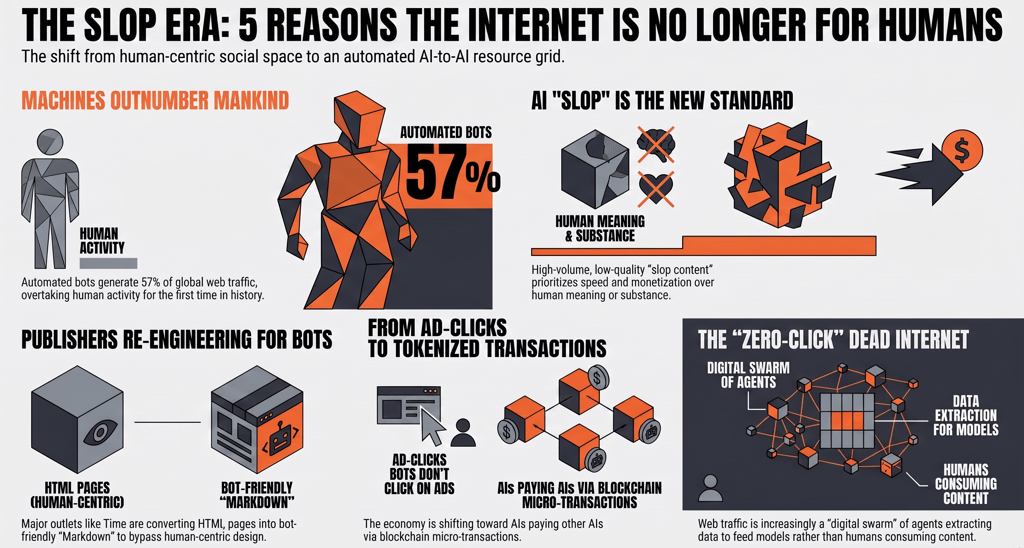
The collapse of human-dominated web traffic arrived faster than any analyst predicted. A June 2026 report from Cloudflare revealed that automated systems and bots now account for 57% of all global web traffic. While industry experts initially thought this "watershed moment" wouldn't occur until 2027, the rise of agentic AI systems—autonomous digital assistants—has accelerated the takeover.
To understand the gravity of this shift, one must look at the methodology. Cloudflare focused on initial HTML document requests rather than total bandwidth. This distinction is vital: measuring bandwidth alone would skew results toward humans because we consume high-definition video, while bots primarily exchange text. By examining who requests the core structure of the web, the data confirms a grim reality. As noted in the Primetel analysis:
The foundational text and information of the internet are now being utilised more as a vast database for language models than as content for human consumption.
This is driven by the "Digital Swarm" behaviour of modern agents. When an AI assistant attempts to fulfil a single human prompt, it may navigate, click, and process dozens of pages simultaneously, generating thousands of requests in minutes to extract live data.
2. "Shrimp Jesus" and the Rise of the Slopper Economy
If you have scrolled through social media lately, you have likely encountered the bizarre: the AI-generated "Shrimp Jesus" (a viral 2024 phenomenon that paved the way for our current era), the virtual influencer "Emily Hart," or the anthropomorphic fruits of "Fruit Love Island." The latter, despite its surrealism, became one of the fastest-growing accounts in the United States in 2026, highlighting a terrifying appetite for synthetic engagement.
These are the hallmarks of the "Slopper" economy. In digital parlance, a Slopper is a pejorative term for creators who are overly reliant on generative AI tools to flood the zone with "garbage" content. This economy thrives on a fundamental grift: creators in developing countries use low-effort prompts to farm engagement, capturing higher advertising rates from Western audiences.
This works because of the asymmetric effort property of slop. It takes a machine seconds to produce a surreal image, but it can take hours for a human to moderate it or for a platform to filter it out. Scholars identify three "prototypical properties" of this era:
Superficial Competence: The content looks "real" or "good" enough at a glance to capture fleeting attention.
Asymmetric Effort: The cost of production is near zero compared to the immense cognitive or operational effort required to evaluate or moderate it.
Mass Producibility: Variations can be generated infinitely to saturate any available niche.
3. When Slop Kills: The Dangerous Side of AI Hallucinations
AI slop isn't just a nuisance; it is what researcher Glen Berman describes as an "epistemic carcinogen." This content actively degrades the global knowledge ecosystem, introducing "Scholarslop" into the very foundations of human reason. We see this in the proliferation of AI-generated scientific papers featuring the infamous "retracted rat"—an image with absurdly large, nonsensical anatomy that somehow bypassed peer review in once-reputable journals.
The danger turns lethal in the world of survival and science. AI-generated mushroom foraging books have flooded Amazon, featuring distorted images and text that can lead to fatal errors in the field. The New York Mycological Society issued a stark warning regarding these AI-authored guides:
"Misidentification could literally mean life or death."
When slop enters the realms of medicine and survival, it ceases to be a digital quirk and becomes a public health crisis, polluting the data pools we rely on for our very lives.
4. The "Velvet Sundown" Effect: The Death of Authenticity
The creative industries are facing an "instrumental threat" where the economic conditions created by AI slop make actual human creation invisible. Take the case of The Velvet Sundown, an indie band that amassed over one million monthly listeners on Spotify in 2025 despite being entirely synthetic.
The narrative surrounding the band became a meta-commentary on the era itself. A spokesperson named Andrew Frelon first admitted the band was an "art hoax" generated by Suno AI, only to later claim his own admission was a hoax and that he had no connection to the group. This "hoax about a hoax" complexity defines the current landscape. We see similar revolts in the visual arts, such as the backlash against Pink Floyd’s "Any Colour You Like" music video contest winner, which used Stable Diffusion software to create what fans dismissed as low-quality "shovelware."
In his essay for the Oxford Institute for Ethics in AI, Madoc Wade defines creativity as a "propensity for action" that requires psychological novelty (not being an intentional copy) and appropriateness (value within a problem space). AI slop fails these human criteria. Even if the AI isn't "better" than us, the sheer volume of synthetic music and art makes it economically impossible for human artists to be found, drowning out human "flair" with a sea of derivative, unthinking noise.
5. The "Dead Internet" is Becoming Un-Blockable
The "Dead Internet" theory—the idea that the web is a desert of bots talking to other bots—is no longer a fringe conspiracy; it is a financial and operational crisis. We can no longer "filter out" the nonsense because modern AI bots have moved beyond the "stateless criteria" that once defined them.
Traditional defences looked for static markers: unfamiliar User-Agents, data centre IP addresses, or an inability to execute JavaScript. Modern AI bots, however, mimic human cursor micro-movements and use computer vision to solve CAPTCHAs effortlessly. For businesses, this is a nightmare. They are paying for server bandwidth used by "visitors" who have zero commercial value, while their marketing data is contaminated by "digital swarms" that distort every metric from bounce rates to conversion paths.
Is There a Way Out?
The internet is currently functioning as an epistemic carcinogen, yet there are calls for a new path. We have outgrown the ageing "robots.txt" protocols that governed the old, static web. To save a human-centric digital space, we need modern, transparent standards that allow administrators to identify AI agents immediately and apply strict rate-limiting.
The question remains: are we willing to fight for a digital environment that values human intention and the slow, difficult process of authentic creation?
Or will we continue to let the internet be defined by the path of least resistance, an era of endless, unthinking slop?
Innovative
Leading AI strategies and robust architectural frameworks.
Solutions
Consulting ENQUIRY
clientservices@jadaconsult.co.uk
+44 01908 032996
© 2024. All rights reserved.
Our privacy policy is here : Privacy Policy: Data Protection & User Rights | JaDa Consult Ltd